 Google Scholar
 DBLP
DBLP ORCID
ORCIDAbout
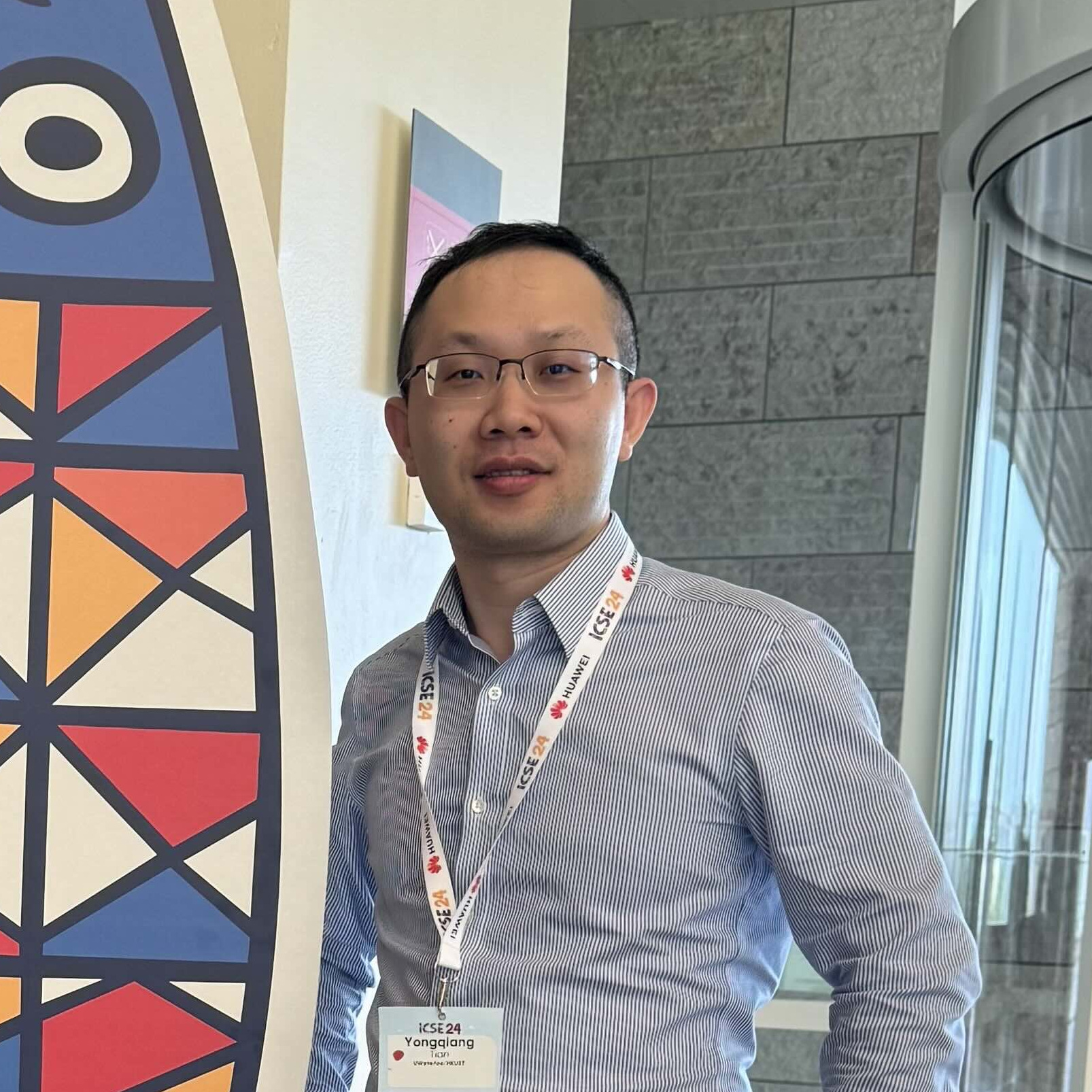
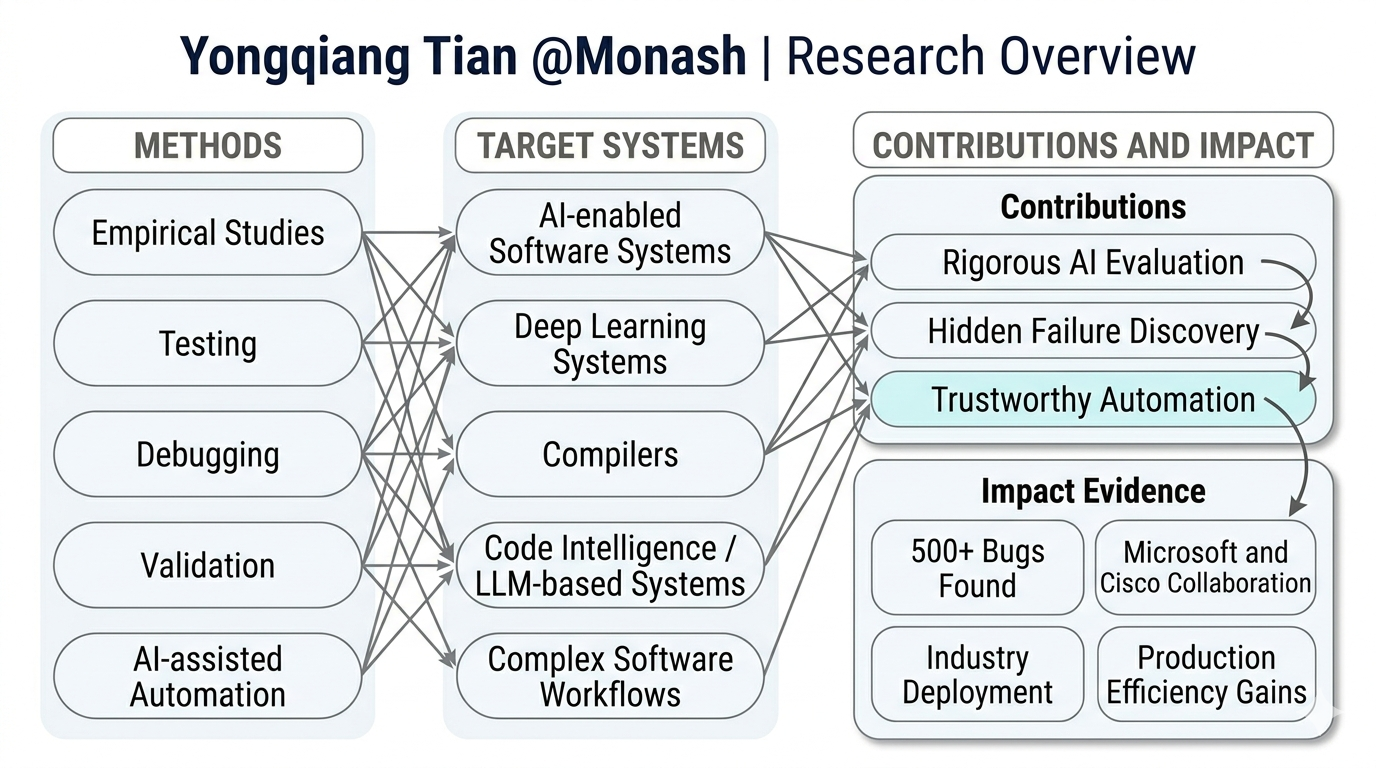
I am Yongqiang Tian, a Lecturer (Assistant Professor equivalent) in software engineering at Monash University, where I lead T³ Lab — Tian's Testing and Trustworthiness Lab. My research focuses on software testing and debugging for reliable and trustworthy AI-enabled software systems, with particular interests in validation, error detection, and automated techniques for reliable and reproducible computing.
I have academic, research, and teaching experience across Hong Kong, Canada, and Australia. Across these settings, I have worked on deep learning systems, compilers, code intelligence, and other technically demanding software workflows where reliability matters.
Two Questions I Care About
Within this broader roadmap, there are two research questions that I keep coming back to:
-
What important properties of software should be tested, but are still not well studied?
Representative examples:
- LPO: Discovering Missed Peephole Optimizations with Large Language Models (ASPLOS 2026)
- To What Extent Do DNN-based Image Classification Models Make Unreliable Inferences? (EMSE 2021)
- An Empirical Study of Bugs in Data Visualization Libraries (FSE 2025)
- Unmasking the Type Inference Capabilities of LLMs for Java Code Snippets (TOSEM 2026)
- How can software be tested and debugged effectively and efficiently with respect to those properties? Representative examples:
More
- Program Reduction 101 (Open Book): A practical and research-oriented guide to program reduction — from Delta Debugging to Perses and syntax-guided reducers. Turn a 3,000-line failing program into a 26-line bug report.
- Publications: Full publication list, selected papers, venue notes, and citation links.
- Openings: Information for prospective Ph.D. students, interns, research assistants, and undergraduate researchers.
- Teaching: Course design and leadership for Monash FIT2109 and FIT5171, student feedback, and teaching experience across Monash, HKUST, and Waterloo.
- Service: ACM SIGSOFT leadership, program committees, journal reviewing, and artifact evaluation.
- Funding & Awards: Grants, fellowship schemes, industry support, and recognition.
- Profiles and Resources: Google Scholar, DBLP, ORCID, LaTeX writing guide, awesome-research collection, and DBLP BibTeX copier tool.